
In short
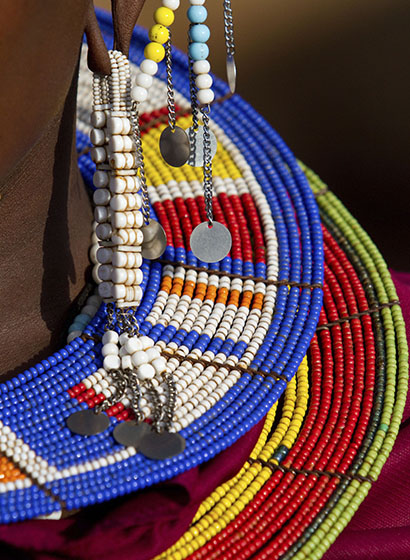
Maasai beadwork uses colour as a language: red for bravery and unity, blue for sky and rain, green for land and health, white for peace and purity, orange for hospitality, yellow for fertility, and black for the people and hardship. Meanings vary between clans, regions and generations.
Maasai beadwork uses colour as a language, and the most widely shared meanings are red for bravery and unity, blue for sky and rain, green for land and health, white for peace and purity, orange for hospitality, yellow for fertility and black for the people and hardship. You can see these colours in Maasai and Samburu beadwork at the Cultural Heritage Centre on Dodoma Road in Arusha.
What does each colour mean in Maasai beadwork?
Each colour links to something central to pastoral life: cattle, land, sky and community. These are the most widely published meanings, but they vary between clans, regions and generations.
Maasai bead colours at a glance
- Red: bravery, strength and unity; linked to the blood of cattle.
- Blue: energy and the sky, which sends the rain that feeds the herds.
- Green: land and health; the pasture that sustains people and cattle.
- White: peace, purity and health; also milk, a staple of the Maasai diet.
- Orange: hospitality, warmth and friendship; often linked to the gourds used to offer milk to guests.
- Yellow: fertility and growth, linked to the sun.
- Black: the people, solidarity and the hardships of life.
Colour rarely works alone. Makers set contrasting blocks side by side, and a piece’s size and style can signal age, marital status or occasion.
Who wears Maasai beadwork, and which pieces?
Women, men and children all wear beadwork, but the pieces differ by gender, age and stage of life. Women wear the most, and some of the grandest pieces mark marriage.
- Flat disc collars: wide, stiff collars worn by women and girls, which move with the wearer during dancing.
- Wedding necklaces: elaborate bridal pieces, often with long beaded strands falling down the front.
- Earrings: beaded ornaments for stretched earlobes and upper-ear piercings; certain styles are worn only by married women.
- Warriors’ adornment: young men of the warrior age set, often called morans, wear beaded headbands, earrings, armbands and belts.
- Bracelets and anklets: worn by almost everyone, young and old.
How is Maasai beadwork made, and by whom?
Beadwork is made by women, who learn it from mothers and grandmothers. A large collar can take many days, with thousands of small glass beads threaded on to wire and built up into precise geometric patterns.
Before glass beads were plentiful, ornaments were made from local materials such as clay, bone, shell, seeds, wood, copper and iron. Glass beads had long reached the coast through Indian Ocean trade, but in the late nineteenth century great quantities of brightly coloured European glass beads arrived in East Africa, giving makers today’s palette.
The Smithsonian’s essay Beaded Splendor traces this history. Some European beads, including layered chevron beads first made in Venice, are now collected as trade beads.
How do Maasai and Samburu beadwork styles differ?
The Samburu of northern Kenya speak a Maa language and share many traditions with the Maasai, so their beadwork is closely related. In broad terms, Maasai women favour wide flat collars, while Samburu women build up many single strands into a thick collar high around the neck.
Among the Samburu, the number of necklaces a woman wears is often said to reflect her status, and married women wear a distinctive necklace of their own. These are tendencies, not rules, and the two communities borrow from each other.
How can you tell authentic hand-beaded work from imports?
Hand-beaded work shows its maker: slight irregularities, firm even tension and a neat reverse. Very cheap, perfectly uniform pieces made with plastic beads are often mass-produced imports.
- Turn it over: the back should show neat stitching or wire work, sometimes on a leather base.
- Feel the beads: glass is cool and has weight; plastic feels light and warm.
- Look for small variations in spacing and bead size, which mass production tends to remove.
- Ask who made the piece and where. A good seller can tell you.
The glass beads themselves have long been imported; authenticity lies in the handwork and design. Our guide to authentic Tanzanian souvenirs applies the same eye to other crafts.
Where can you see Maasai beadwork in Arusha?
At the Cultural Heritage Centre on Dodoma Road, you will find Maasai beadwork in The Vault and The Market. Entry to the galleries, market and workshops is free, and the Centre is open every day; check the Visit page for current hours.
- The Vault: the jewellery house holds Maasai and Samburu beadwork necklaces and bracelets, plus chevron and trade-bead necklaces.
- The Market: crafts and keepsakes, including Maasai beadwork, sold at the Centre itself.
- The Collectors: the art gallery’s Faces of Africa and Women of Africa rooms hold oil and acrylic paintings by East and Southern African artists.
Frequently asked questions
Do Maasai colour meanings vary between communities?
Yes. The meanings most often quoted, such as red for bravery and white for peace, are widely shared, but interpretations vary between clans, regions and generations. The safest reading is that the colours point to cattle, land, sky and community.
Is Maasai beadwork made only by women?
Traditionally, yes. Beadwork is a women’s craft, learned from mothers and grandmothers and practised throughout life. Men and boys wear plenty of beadwork, especially young warriors, but the pieces are generally made by women.
What are chevron trade beads?
Chevron beads are layered glass beads, first made in Venice in the late fifteenth century, whose ground ends reveal a star pattern of coloured layers. Traded into Africa for centuries alongside other European glass beads, they are now prized by collectors. The Vault at the Cultural Heritage Centre in Arusha has chevron and trade-bead necklaces.
Is it free to see the beadwork at the Cultural Heritage Centre?
Yes. Entry to the galleries, market and workshops at the Cultural Heritage Centre on Dodoma Road, Arusha, is free, and the Centre is open every day. It is about 15 minutes’ drive from Arusha town centre. Check the Visit page on culturalheritagetz.com for current opening hours.
How do I buy a beadwork necklace from The Vault?
Browse The Vault online, add the pieces you like to My selection and request a quote. Prices are given on request and quoted in US dollars, with payment by card payment link or bank transfer. You can also see pieces in person at the Centre, or call or WhatsApp +255 748 078 278.
Beadwork is best understood up close, where you can see the stitching and feel the weight of the glass. Plan your visit to the Centre on Dodoma Road, or browse Maasai beadwork in The Vault before you come.
