
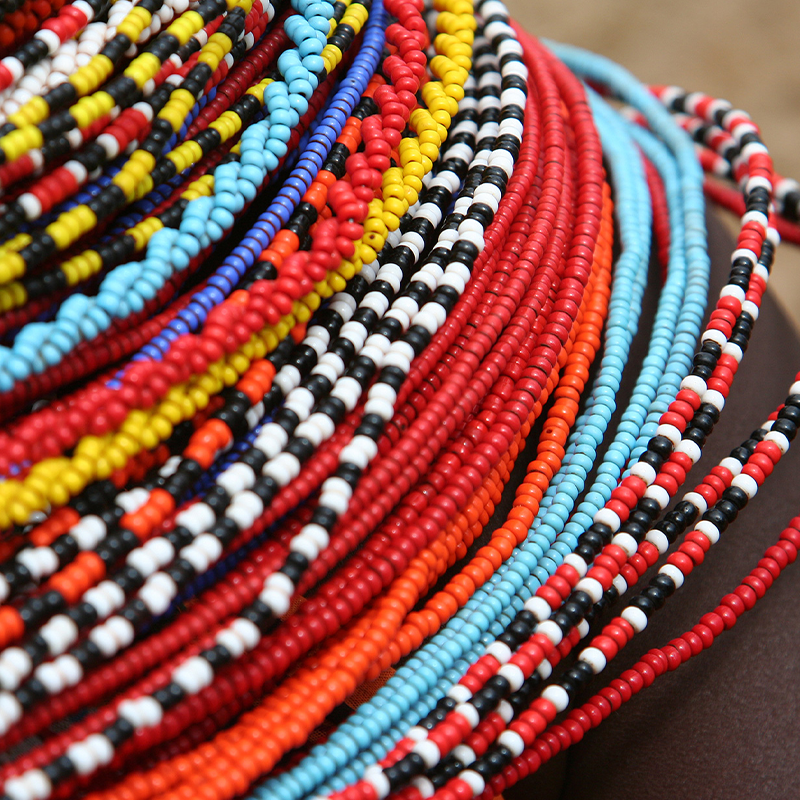
Maasai beadwork is made by hand, mostly by Maasai women, who string glass seed beads onto wire or thread, hold the rows in place with stiff spacers, and shape them into collars, necklaces and bracelets, a skill passed from mother to daughter. At the Cultural Heritage Centre on Dodoma Road in Arusha, you can see and buy Maasai and Samburu beadwork every day, with free entry.
Maasai beadwork at a glance:
- Makers: Maasai women in Tanzania and Kenya, who learn as girls and refine the skill for life.
- Materials: glass seed beads, fine wire, strong thread, and spacers of stiff cowhide, bone or, today, plastic.
- Forms: flat disc collars, necklaces, bracelets, earrings and headbands.
- Time: hours for a simple bracelet; days to weeks for a broad collar.
- Where to see it: Maasai beadwork in The Vault and The Market at the Centre.
What is Maasai beadwork made from?
Modern Maasai beadwork is built from small glass seed beads, fine metal wire, strong thread and stiff spacers, often cut from cowhide. Every bead is placed by hand, with only a few simple tools.
Before glass, beads were made from local materials such as clay, shell, bone, seeds, wood and metal. Large quantities of European glass seed beads reached East Africa in the late nineteenth century, and women adopted them and developed richer colour schemes, as the Smithsonian’s essay on African beadwork describes.
Wire gives a collar its stiffness and holds its flat shape, while thread, now usually nylon, suits softer strands and fringes.
How is a Maasai beaded collar made, step by step?
Beads are strung onto wires of graduated length, and the wires are held apart by pierced spacers so the collar lies as a smooth, flat disc. Most of the skill lies in keeping the pattern aligned row after row.
- Plan: the maker settles the width, rows and pattern, usually from memory.
- Prepare the spacers: strips of stiff cowhide, bone or plastic are pierced at even intervals, one hole per row.
- Measure the wires: each wire is slightly longer than the one inside it, so the collar spreads outwards from the neck.
- String and space: beads are counted onto each wire in sections, with the wire passing through a spacer between sections, so blocks of colour line up across the rows.
- Finish: the ends are secured, fringes or drops may be added, and a leather tie or loop fastening closes the collar.
How long does a Maasai beaded collar take to make?
It depends on size and detail. A simple bracelet can be finished in a few hours, while a broad, many-rowed collar takes days or weeks, and elaborate ceremonial pieces longer still.
Beading fits around other work, such as milking, fetching water and firewood, cooking and caring for children, so it happens in short sessions over many days. A broad collar can hold thousands of beads.
How are beadwork skills passed down between generations?
Girls usually learn from their mothers, grandmothers and older sisters, starting with simple strands and working up to complex collars as their hands and eye for pattern develop.
Beading is often shared work: women bead together and talk, while younger girls watch, sort beads and try small pieces. Over time each maker develops her own touch.
Ornaments also mark stages of life, so learning to bead means learning a visual language, explained in our guide to what Maasai beadwork colours mean.
How does buying Maasai beadwork support the women who make it?
Beadwork is one of the main ways many Maasai women earn money of their own, so buying from makers, or from sellers who pay them fairly, puts money into their households.
- Ask where a piece was made and by whom; a good seller can tell you.
- Pay fairly for handwork rather than bargaining down to the cost of the beads.
- Choose pieces that show care: tight, even rows, secure ends and a flat shape.
At the Cultural Heritage Centre, Maasai beadwork is sold in The Market alongside carvings, Tanzanian coffee and other authentic Tanzanian souvenirs. The Vault holds Maasai and Samburu beadwork necklaces and bracelets, plus chevron and trade-bead necklaces. Vault prices are on request: add pieces to “My selection” for a quote in US dollars.
How do you care for Maasai beadwork?
Keep it dry, store it flat and clean it gently with a soft, slightly damp cloth. Water, heat and bending do the most harm, because they weaken leather and distort the wire.
- Never soak beadwork; water can stiffen and shrink cowhide and loosen thread.
- Apply perfume and sunscreen before you dress, and take beadwork off to swim.
- Store collars flat in soft cloth, and never fold them; bent wire rarely straightens cleanly.
- If a row loosens, stop wearing the piece and have it repaired before beads are lost.
Frequently asked questions
Who makes Maasai beadwork?
Maasai beadwork is traditionally made by women, who learn as girls from their mothers and grandmothers. Men wear beadwork, especially at ceremonies, but the making is mostly women’s work, and selling it is an important source of income for many Maasai families in Tanzania and Kenya.
How can you tell if Maasai beadwork is handmade?
Handmade pieces show small variations in bead size and spacing, yet the rows stay tight and the pattern lines up. Turn a collar over and you should see wire threaded through pierced spacers and neatly finished ends. Very uniform, lightweight pieces strung on elastic are more likely to be factory-made.
Where can I buy Maasai beadwork in Arusha?
The Cultural Heritage Centre on Dodoma Road, about 15 minutes’ drive from Arusha town centre, sells Maasai beadwork in The Market and holds Maasai and Samburu beadwork necklaces and bracelets in The Vault. The Centre is open every day and entry is free; check the Visit page for current hours.
How should I pack Maasai beadwork for the flight home?
Lay collars flat between folded clothes in the middle of your suitcase, or carry them in hand luggage, to protect them from bending and crushing. Wrap each piece in soft cloth to stop wires catching, and keep beadwork away from toiletries that might leak.
To see Maasai beadwork in person, plan a visit to the Cultural Heritage Centre, open every day with free entry, and browse the pieces in The Market. If you are not in Arusha, explore Maasai beadwork in The Vault online and request a quote.
